It was time to head home(Gwanghwamun to Seochon: An Aesthetic Walking Route for Coffee, Indie Films, and Photobooth Hopping), but I felt like something was missing. Maybe it was the bread and ice cream I’d had earlier, but as a Korean, my soul was craving something savory—a warm, comforting broth. As I walked from Seochon(서촌) back toward Gwanghwamun(광화문), I pondered over options like kalguksu (칼국수) or jjamppong (짬뽕). I checked my “Saved” list on Naver Map, and then—Eureka! It had to be North Korean-style manduguk (만두국/dumpling soup). I decided to head to Pyeongando Mandujip(평안도 만두집), located in the basement of an office building in Gwanghwamun.
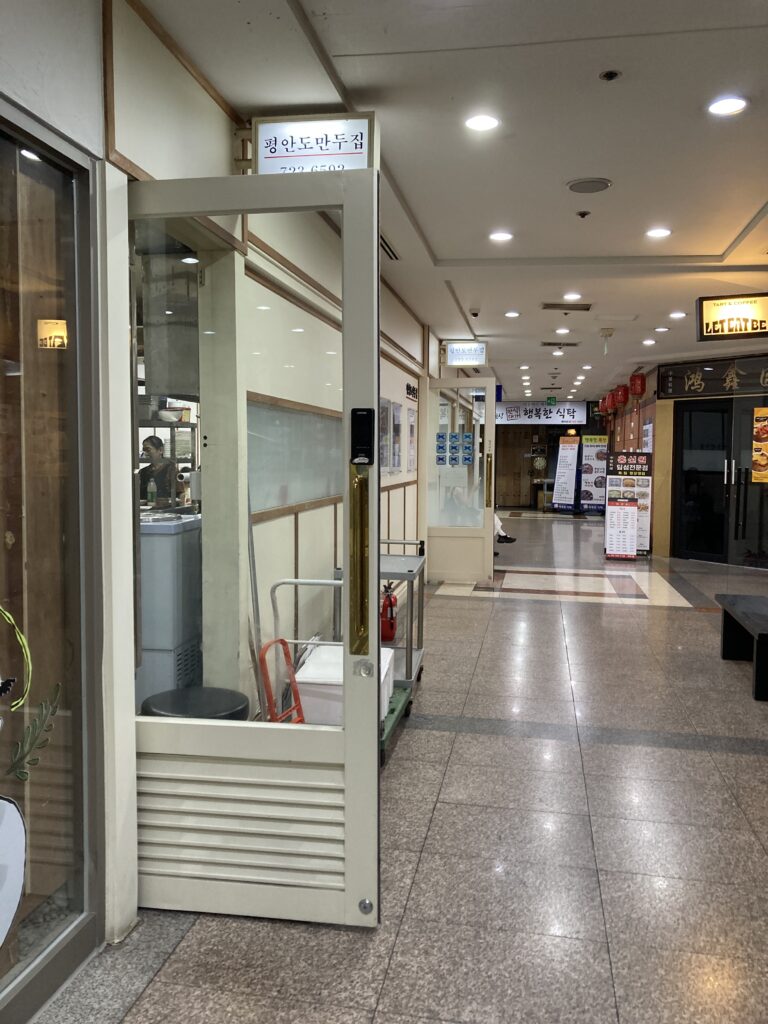
Pyeongando Mandujip (평안도만두집)
- Address: B104, 30, Saemunan-ro 3-gil, Jongno-gu, Seoul
- Hours: 11:00 – 21:00 (Break time: 15:00-17:00) / Closed on Sundays
- Map: Google Maps | Naver Map (Recommended for navigation in Korea)
Seoul’s business districts, like Yeouido(여의도) and Gwanghwamun(광화문), are filled with hidden restaurants tucked away in the basements of office buildings. For travelers, these spots are goldmines—these are where the local office workers eat every day. Of course, that goes for me, a local Seoulite, as well!
+A quick word of caution: since these places cater primarily to office workers, many close early on weekends or are completely shut on Sundays. Always double-check the operating hours on Naver Map before you go. Pyeongando Mandujip, for instance, is closed on Sundays.
Descending into the basement, I saw a sea of closed storefronts, but one place was bustling—our destination. Luckily, there was exactly one table left, and we slid right in. (There are only about 10 tables, so you might need to wait during peak hours. However, since the turnover is quite fast, it shouldn’t take too long.)
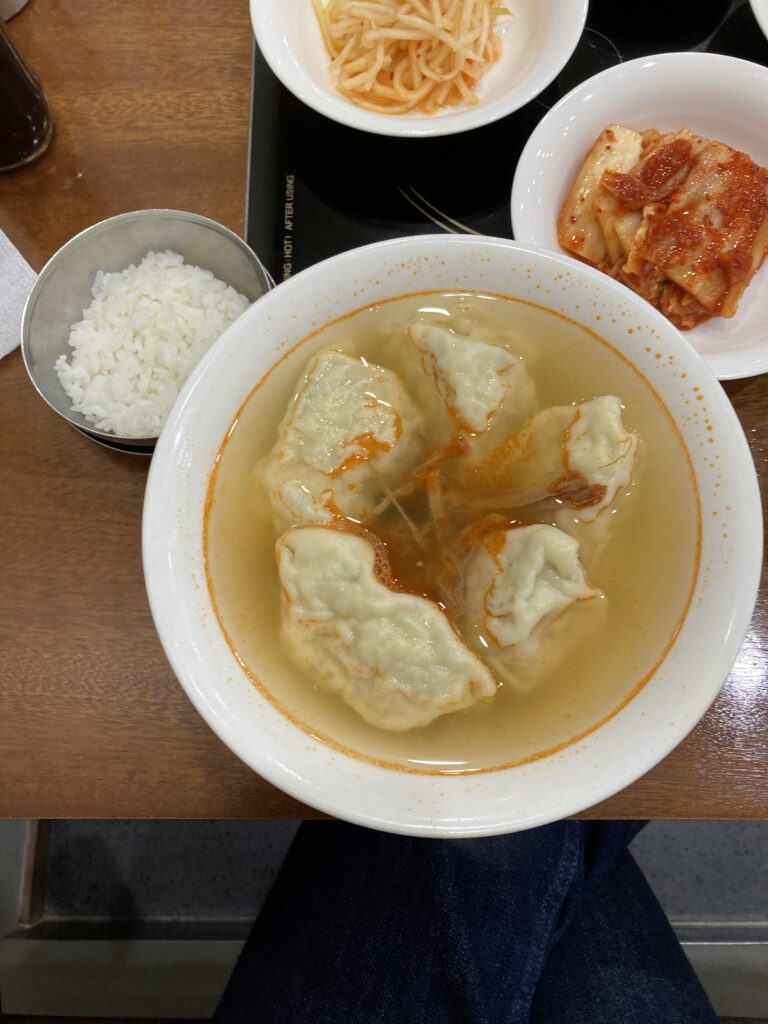
We ordered as soon as we sat down. The manduguk (만두국/dumpling soup) arrived shortly after: a clear, rich meat broth topped with a dash of red chili oil and garnished with seasoned meat. Personally, I absolutely loved the broth. The dumplings themselves were mild, light, and clean, making the harmony between the dumplings and the savory broth feel effortless to slurp down. The soup comes with a small bowl of rice, which is a must-add to the remaining broth at the end of your meal. I’ve already decided that next time, I’m ordering a side of steamed dumplings (jeopsi-mandu/접시만두), too!
Safe travels, Soy Kim
+ Wondering about the other side of Seoul’s dumpling scene?
Check out my guide to Bukchon’s Kkangtong Mandu, which features a savory bone-broth base.
Like a Local in Gahoe-dong & Samcheong-dong: A 5-Hour Route for Mandu, Craft Museum, and Cafes
One Comment